Exporting Moonstone from Pakistan: A Practical Guide for International Buyers
Buyers researching moon stone export from Pakistan are rarely asking a purely technical question. They want to know whether the stones will look like the sample, how identity and quality are proven, what paperwork a gemstone shipment needs, and what is changing in Pakistan’s gemstone sector. Because gemstones are priced by judgement as much as by measurement, the buying process rewards clarity. This guide covers what moonstone is, how its quality is judged, how an export shipment is organised and what to watch for along the way.
What Is Moonstone?
The Gemological Institute of America describes moonstone as a variety of the feldspar-group mineral orthoclase, made up of two feldspar minerals, orthoclase and albite. As the mineral cools, the two separate into thin alternating layers. Light entering between those layers scatters, producing adularescence, a glowing sheen that appears to move across the stone as the viewing angle changes.
GIA also notes that other feldspars can show the same effect. “Rainbow moonstone,” for instance, is actually a variety of labradorite, and sanidine can also produce adularescent stones. For a buyer, this means the trade name alone does not tell you what you are getting. Ask what the stone is and how it was identified.
How Moonstone Quality Is Judged
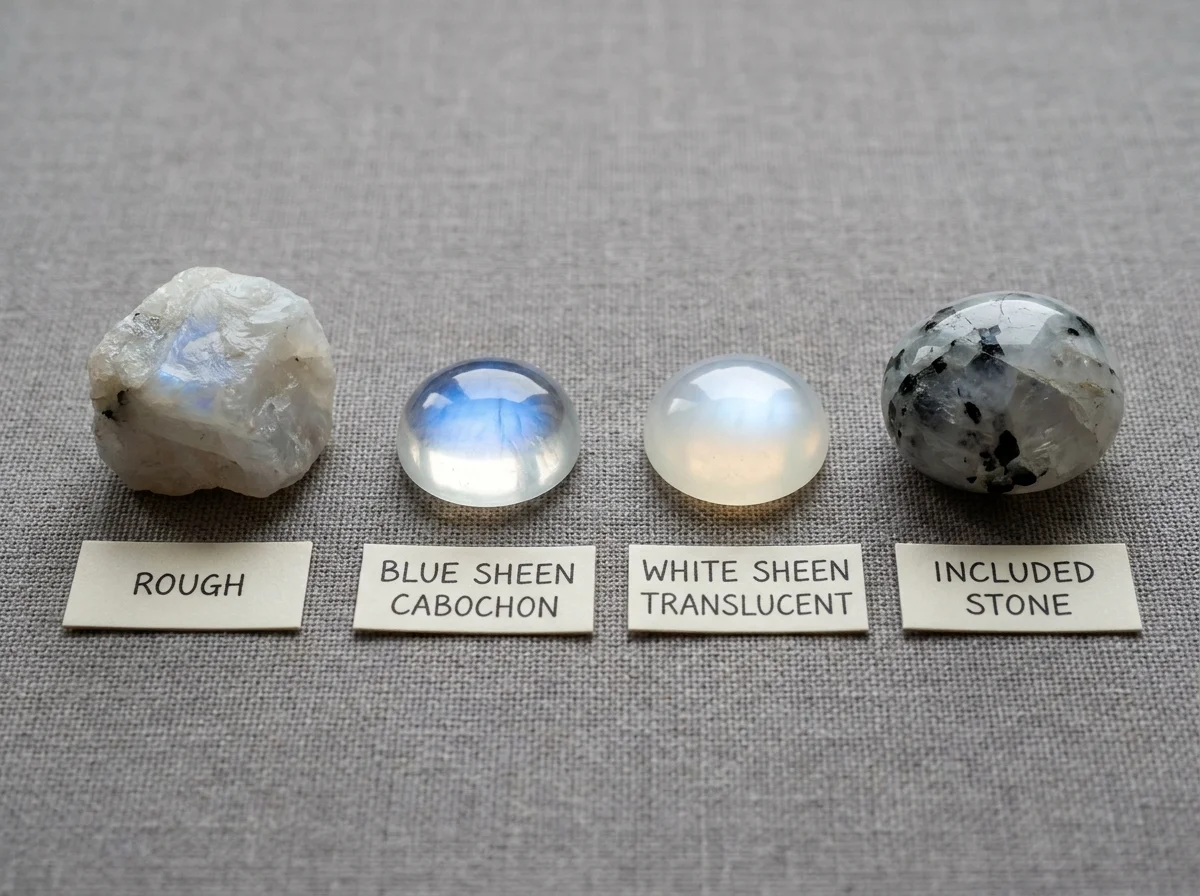
Gem buyers assess moonstone through a handful of visual features rather than a single grade. Daa Minerals says it reviews rough or selected moonstone pieces by colour, optical response, transparency, inclusions, surface condition, shape and buyer-defined sizing, which closely matches how buyers think.
Optical Response
The strength and character of the adularescence is usually the first thing a buyer looks at. GIA notes that a blue sheen against a colourless background is a particularly prized combination.
Colour and Body Colour
Body colour can range widely, and buyers often prefer particular looks for particular markets.
Transparency and Inclusions
Clearer material tends to show the effect differently from translucent or cloudy stone, and inclusions affect both appearance and durability.
Surface Condition and Shape
With rough, the way a piece is likely to be cut matters. GIA observes that the shimmer is visible even in rough and that a quality cut maximises it, so cutting orientation influences the final result.
Size and Consistency
For parcels, buyers need to know how uniform the lot is, not just how good the best piece looks.
Rough, Cabochon or Finished: Choose the Form First
Moonstone is traded as rough pieces, shaped or polished cabochons and finished stones, and each is evaluated differently. With rough, you are betting on what the material will yield, so the supplier’s selection and your cutting experience matter. With polished stones, you judge the finished appearance directly. State the form you want in your first enquiry, because it determines preparation, packing and customs classification.
Verifying Identity and Treatments
Because several feldspars can show similar effects, identity and any treatment should be documented rather than assumed. Ask for a clear statement of what the material is, whether it has been treated, and what evidence supports that. For higher-value parcels, a report from a recognised gemmological laboratory adds confidence, and it should remain attributable to the laboratory that issued it. Daa Minerals says it does not operate a laboratory and instead coordinates third-party testing or inspection where requested and agreed, as described on its Quality and Certifications page. Agree the testing provider and scope with the supplier in writing before shipment.
Pakistan’s Gemstone Sector: What Buyers Should Know
Pakistan’s gemstone sector is going through policy change. The government has approved a National Gemstone Policy for 2026 to 2030 which, according to Business Recorder’s report, proposes a National Warranty Office to standardise inspection, valuation, certification and sealing of export consignments, minimum export price benchmarks, Pakistan-specific HS codes and a National Gemstone Business Registry linked to customs, banking and certification systems. ProPakistani reports that the ministry puts official gemstone exports at only about $5 million to $7 million a year.
These are policy proposals and reported figures, and implementation will take time, so do not assume any single requirement is already in force. Before a shipment, ask your supplier and customs broker which certification, valuation or registration steps currently apply to the specific goods you are buying.
Customs Classification for Moonstone
Gemstones fall under Chapter 71 of the Harmonized System, and heading 7103 covers precious stones other than diamonds and semi-precious stones. Within it, unworked, sawn or roughly shaped stones sit under subheading 7103.10, while worked stones sit under 7103.91 and 7103.99. The World Customs Organization maintains the six-digit system used by more than 200 countries and economies, and national tariff lines add further digits. Because Pakistan has proposed its own gemstone-specific codes, confirm the current national classification with your customs broker and keep the description consistent across the invoice, packing list and declaration.
The Moonstone Export Process, Step by Step
1. Define the requirement. Specify form (rough, cabochon or finished), size range, colour and sheen preferences, quantity and destination.
2. Review selection samples. Compare the sample against your written criteria, not against memory.
3. Verify identity and treatment. Agree a laboratory and scope where the value justifies it.
4. Agree commercial terms in writing. Cover specification, tolerance, price basis, delivery term and payment.
5. Prepare and pack. Sorting, grading and secure packing with lot identification.
6. Complete customs and certification steps. Pakistani exporters file through the Pakistan Single Window, which offers a Single Declaration for exports.
7. Ship with traceable, insured transport. Gemstones are small and valuable, so insurance and sealed packaging deserve attention.
8. Receive and verify. Check the delivered parcel against the invoice and the agreed criteria immediately.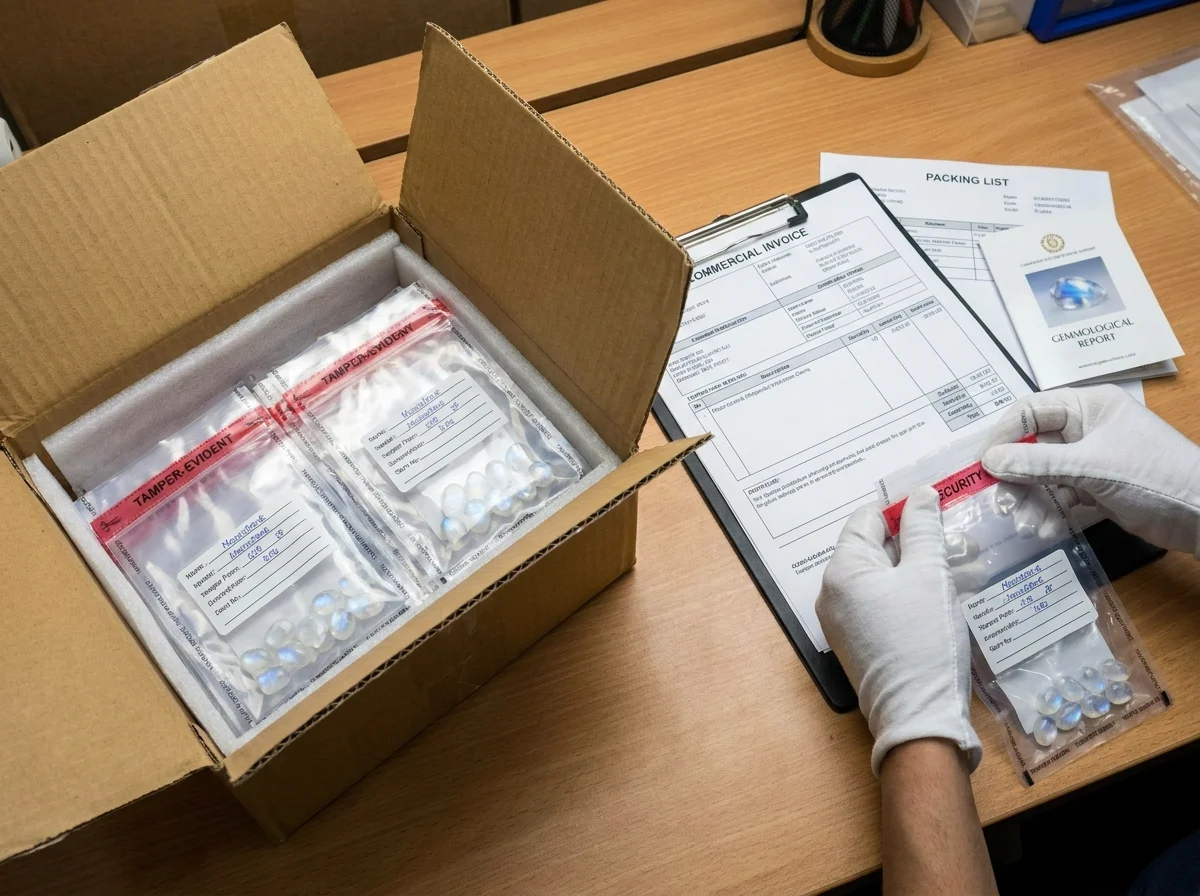
Delivery Terms and Payment
For small, high-value parcels, buyer and seller should agree exactly who is responsible for transport, insurance and customs at each stage. The International Chamber of Commerce publishes the Incoterms rules, a set of eleven terms that clarify tasks, costs and risks between seller and buyer. Name the term and the delivery point in the contract. As with any export, many buyers link payment stages to evidence such as sample approval, laboratory confirmation and shipping documents instead of paying in full in advance.
Key Risks and How to Reduce Them
The main risks are mislabelled material (a different feldspar sold as moonstone), undisclosed treatment, parcels that do not match their sample, and paperwork gaps that delay customs clearance. A written specification, documented identity, a sealed lot and a clear return or remedy clause address most of them. Ask for photographs or video of the actual parcel rather than stock images, and compare the delivered goods with them.
Making an Enquiry with Daa Minerals
When you are ready to discuss a requirement, share the form, colour and sheen preferences, size range, quantity and destination through the Daa Minerals contact page. The company lists moonstone in its mineral portfolio and states that availability, grade and pricing remain subject to source review, buyer approval and written agreement. You can also submit a buying requirement through DaaTrade.
Final Thoughts
A good moonstone export from Pakistan rests on three habits: describe what you want in detail, document what you receive, and confirm the current rules rather than assuming them. With the sector’s policy framework still evolving, buyers who keep their specifications, identity evidence and paperwork in order are best placed to benefit.
Moonstone Export: Frequently Asked Questions
Is moonstone a single mineral?
Not exactly. GIA describes moonstone as a variety of the feldspar mineral orthoclase, but other feldspars such as labradorite and sanidine can also show moonstone-like adularescence.
Should I buy rough or polished moonstone?
It depends on your business. Rough involves less processing cost but carries yield uncertainty, while polished stones let you judge the finished look directly.
Do I need a laboratory report?
For higher-value parcels, it is advisable. Agree the laboratory and scope with the supplier before shipment.
What HS heading covers moonstone?
Heading 7103 covers precious and semi-precious stones, with separate subheadings for unworked and worked stones. Confirm the current national code with your customs broker.