Importing Moonstone from Pakistan: A Step-by-Step Guide for International Buyers
Importers who want to import moonstone from Pakistan face a different set of questions from the people selling it. How do I confirm what I am buying? Which documents will my customs authority ask for? Who is responsible if a parcel is lost or damaged? What should I check before releasing payment? This guide follows the process from the importer’s side, from choosing a supplier to clearing the goods and verifying them on arrival.
Step 1: Understand the Product and Your Market
Start with what moonstone is and how its value is judged. The Gemological Institute of America describes it as a variety of the feldspar mineral orthoclase, in which layers of orthoclase and albite scatter light to produce adularescence. GIA also notes that other feldspars, including labradorite and sanidine, can show similar effects.
Then decide what your market wants: rough for cutters, cabochons for jewellers or finished stones. Daa Minerals says it reviews moonstone by colour, optical response, transparency, inclusions, surface condition, shape and buyer-defined sizing. Write your own criteria along the same lines, with reference photographs where possible. A precise brief is the most useful tool you will have.
Step 2: Check Import Rules in Your Own Country
Gemstone import rules vary by country, and no single guide can cover every jurisdiction. Before placing an order, ask your customs authority or broker about:
• The tariff code and duty rate for the form you are importing
• Any import licence, registration or declaration requirements for gemstones
• Documents required, such as a commercial invoice, packing list and certificate of origin
• Value-added or sales tax treatment
• Rules on testing, labelling or disclosure of treatments
Gemstones sit in Chapter 71 of the Harmonized System, under heading 7103 for precious and semi-precious stones, with separate subheadings for unworked, sawn or roughly shaped stones and for worked stones. The World Customs Organization maintains the six-digit system used by more than 200 countries and economies, but each country adds its own digits and duty rates. Your broker’s confirmation of the exact code matters more than any general guide.
Step 3: Choose and Vet Your Supplier
Supplier types include miners, cutters, dealers and export coordinators. Daa Minerals Limited is a Pakistan-based export coordinator, describing its role as requirement review, sourcing, preparation coordination, packaging, documentation and shipment support within a written scope. Its sister platform DaaTrade presents itself as an export desk that sources from Pakistani suppliers.
Whoever you choose, vet them the same way. Verify company details independently, and ask how they identify and describe the stones, whether treatments are disclosed and what documentation they provide. Request photographs or video of the actual parcel and compare them with what arrives. Daa Minerals states that final technical suitability remains with the buyer, so build your own checks into the process.
Step 4: Understand Pakistan’s Export Requirements
Pakistan’s gemstone sector is changing. Business Recorder reports that the government has approved a National Gemstone Policy that proposes a National Warranty Office to inspect, value, certify and seal export consignments, minimum export price benchmarks, Pakistan-specific HS codes and a business registry linked to customs and banking systems. Whether any of these apply to your shipment depends on how far they have been implemented, so ask your supplier which certification, valuation and sealing steps currently apply, and make sure the documents they provide match what your own customs authority expects.
Pakistani exporters file declarations electronically, and the Pakistan Single Window offers a Single Declaration for exports. Ask your supplier to confirm how the shipment will be declared and to share the relevant references.
Step 5: Verify Identity, Treatment and Quality
Do not rely on the word “moonstone” on an invoice. Ask for written confirmation of what the material is and whether it has been treated, and for higher-value parcels, commission an independent gemmological report from a laboratory you trust. Daa Minerals says it coordinates third-party testing and inspection where requested and agreed, while the laboratory issues its own report, as explained on its Quality and Certifications page. Agree the laboratory, scope and timing before shipment, and make sure the report refers to the specific parcel you are buying.
Step 6: Agree Commercial Terms in Writing
A purchase contract should cover:
1. The description of the parcel, form, size range and quality standard
2. Treatment disclosure
3. Quantity, tolerance and weighing or counting method
4. Price basis, currency and validity
5. Delivery term and named delivery point
6. Packaging, sealing and labelling
7. Insurance and who pays for it
8. Payment terms and staged release
9. Remedies if the parcel does not match the agreed standard
For the delivery term, use the International Chamber of Commerce’s Incoterms rules, which clarify who handles tasks, costs and risks between seller and buyer. Name the term, the delivery point and the party responsible for insurance instead of relying on phrases like “shipping included.”
Step 7: Match Payment to Verification
Gemstones are high in value relative to their size, so the way you pay deserves thought. Large prepayments made before sample approval and laboratory confirmation leave you with little recourse if the parcel disappoints. Many importers prefer staged payments tied to evidence such as approved samples, a laboratory report, a sealed parcel and shipping documents. The right structure depends on your bank, your risk tolerance and the supplier’s terms, so raise it at the quotation stage.
Step 8: Arrange Secure Shipping and Insurance
Small, valuable parcels need sealed, labelled packing, traceable transport and insurance that covers loss and damage in transit. Confirm the carrier or courier’s rules for gemstones, which can differ from general cargo, and keep the tracking and sealing details. Store the invoice, packing list and any laboratory report together with the parcel records, as your customs authority may ask for them.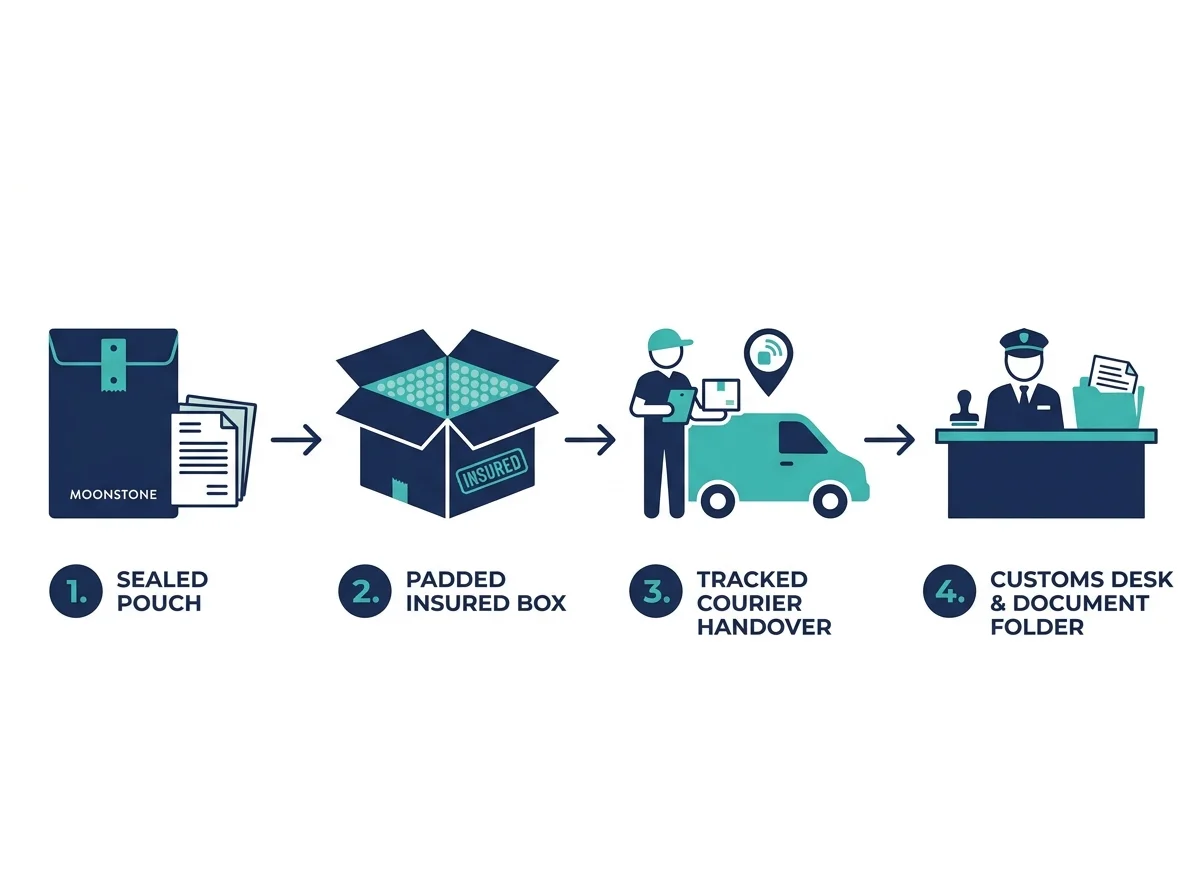
Step 9: Clear Customs and Verify the Parcel on Arrival
When the parcel arrives, check that the seals are intact before opening it, and ideally record the opening on video. Compare the contents with the invoice, the agreed standard and the reference photographs, and weigh or count as agreed. If anything differs, notify the supplier immediately and in writing, because contract claims often have time limits. Keep the evidence, including photographs and the sealed packaging, until the matter is resolved.
Common Mistakes Importers Make
The most frequent are accepting “moonstone” without documented identity, skipping treatment disclosure, paying in full before verification, agreeing a delivery term without naming the point where risk transfers, and assuming that Pakistani export procedures match your own country’s import requirements. Each is solved by writing more down before the order.
Starting an Import Enquiry
When you are ready, share your form, sheen and colour targets, size range, quantity, destination country and delivery term through the Daa Minerals contact page. The company lists moonstone in its mineral portfolio and states that availability, grade and pricing remain subject to source review, buyer approval and written agreement. You can also submit a requirement through DaaTrade.
Final Thoughts
Importing moonstone from Pakistan is manageable when you treat it as a documentation exercise as much as a buying one. Learn your own country’s rules first, verify identity and treatment, write the terms down, tie payment to evidence and inspect the parcel on arrival. Do these things consistently, and each later order becomes easier than the last.
Importing Moonstone: Frequently Asked Questions
Do I need a licence to import gemstones?
It depends on your country. Ask your customs authority or broker about licences, registrations and declarations before ordering.
Which HS heading applies to moonstone?
Heading 7103 covers precious and semi-precious stones, with separate subheadings for unworked and worked stones. Your broker should confirm the national code.
Should I pay in advance?
Many importers avoid full prepayment and instead tie payment stages to approved samples, a laboratory report and shipping documents.
What should I do if the parcel does not match the agreement?
Document the difference with photographs, keep the packaging and seals, and notify the supplier in writing straight away, following the remedy terms in your contract.